Loading Forvm homepage…

Loading Forvm homepage…
Analyzing cash flows and reinvestment across 10 Indian consumer brands shows that high paper returns often hide real cash traps. While factory-free brands like Mamaearth rely on stretched supplier credit to post strong returns, physical-first compounders like Trent and Bikaji aggressively self-fund new stores and factories while retaining massive free cash flow—proving durable growth comes from productive assets, not accounting shortcuts.
Explore dynamic charts, regression models, sensitivity analyses, and raw data tables in a dedicated interactive view.
Across the first three parts of this series, we tracked how 10 listed Indian consumer and retail brands spend on customer acquisition, handle raw-material inflation, and manage inventory and vendor credit. That brings us to the final question that matters most to any business owner or investor: once the bills are paid and new stores or factories are funded, how much real cash is actually left over?
To answer that, I measured each company's Free Cash Flow (operating cash minus annual expansion spending), its Return on Capital (using a standardized 15% operating profit baseline against gross physical and working capital), and its Reinvestment Rate—how much of its annual profit must be plowed back into stores, factories, or inventory just to keep growing.
When you line all 10 brands up on cash generation and reinvestment, four clear realities stand out.
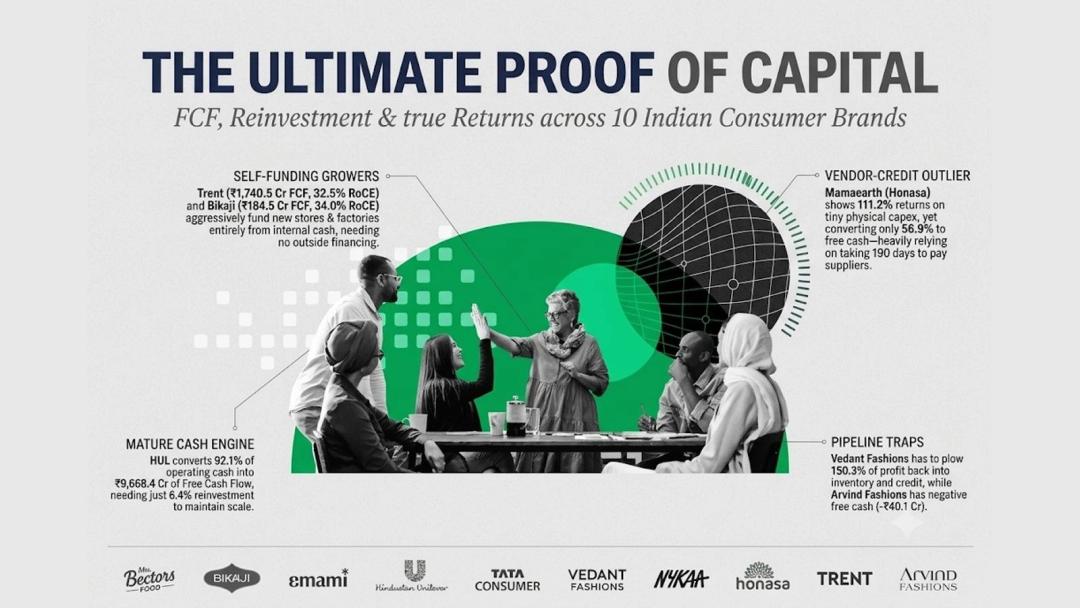
Trent (Zudio and Westside) spends roughly ₹890 Cr a year opening new retail stores—reinvesting 48.5% of its after-tax operating profit—yet still generates ₹1,740.5 Cr in free cash flow (66.2% cash conversion) and a 32.5% return on capital. Bikaji Foods follows the exact same blueprint on the manufacturing side: investing ₹109 Cr a year into modern snack plants (40.1% reinvestment rate) while keeping ₹184.5 Cr in free cash (62.8% cash conversion) and earning a 34.0% return on capital. Neither needs outside capital or stretched vendor bills to fund rapid expansion.
The Final Takeaway Looking across all four parts of this study, a clear truth emerges: there is no free lunch in consumer brands. Outsourced brands save on factory costs upfront but pay through customer acquisition ads, heavy warehouse stock, and vendor dependencies. Physical-first brands like Trent and Bikaji put real money into stores and factories upfront—and in return, they earn faster inventory turns, inflation protection, and self-funding free cash flow that compounds year after year.
Concise LinkedIn Post (Ready to Copy-Paste) Most people judge consumer brands by revenue growth or gross margins. But the real test is simple: how much cash is left over after funding new stores, factories, and stock?
Looking at cash flows and reinvestment across 10 Indian consumer brands shows four clear patterns:
Self-funding winners: Trent spends ~₹890 Cr a year opening stores and still keeps ₹1,740 Cr in free cash. Bikaji invests ~₹109 Cr a year into snack factories and keeps ₹185 Cr in free cash—both earning ~33–34% returns on capital without relying on stretched supplier credit.
The vendor-credit illusion: Mamaearth (Honasa) shows a huge paper return on capital (111%) because it owns almost no plants, but converts just 57% of its operating cash into free cash—and relies on taking 190 days to pay suppliers.
Growth that eats cash: Vedant Fashions has to plow 150% of its operating profit back into inventory and store credit just to support its retail pipeline.
The mature cash engine: HUL reinvests just 6.4% of its operating profit, turning 92% of its operating cash (₹9,668 Cr) into pure free cash flow.
In retail and consumer goods, you either build physical assets that fund their own growth—or you spend your cash keeping warehouses and ad algorithms fed.
Questions, alternative perspectives, useful resources, and reviews from fellow researchers and readers.
Comparing live stock market pricing across 10 Indian consumer peers reveals that standard earnings multiples routinely hide real cash payback timelines. The public market pays a steep upfront premium for asset-light top-line growth (like Honasa at 245.4x EV/FCF), while heavily discounting highly efficient, self-funding operators (like Bikaji and Bectors) that own their production—proving that market-pricing metrics rarely reflect true operational risk or free cash flow
The textbook pitch for factory-free consumer brands is that outsourcing frees up capital for superior returns, but a statutory analysis of 10 listed Indian players reveals that skipping the factory floor actually forces brands to become inventory-heavy in the warehouse—carrying nearly three times more finished stock (an average of 90 days vs. 32 days for in-house manufacturers) to satisfy third-party order minimums. While some outsourced brands like Honasa (Mamaearth) still post strong cash returns by stretching supplier payables to 190 days to fund this slow-moving stock, physical-first compounders generate durable, resilient cash without relying on vendor credit—Trent by investing heavily in storefronts that collect customer cash almost instantly, and Bikaji by running high-velocity, owned snack factories that turn inventory every three weeks. Ultimately, every consumer model pays a capital tax; the winning formula lies not in being "asset-light," but in ensuring capital isn't trapped in bloated warehouse buffers or high customer acquisition costs.
In public markets, investors often fall in love with high product margins. Looking closely at five years of annual financial reports across ten major Indian consumer and retail companies tells an entirely different story. Once you connect what a company spends to make its products with what it spends to get customers to buy them, that apparent advantage disappears.


