Loading Forvm homepage…

Loading Forvm homepage…
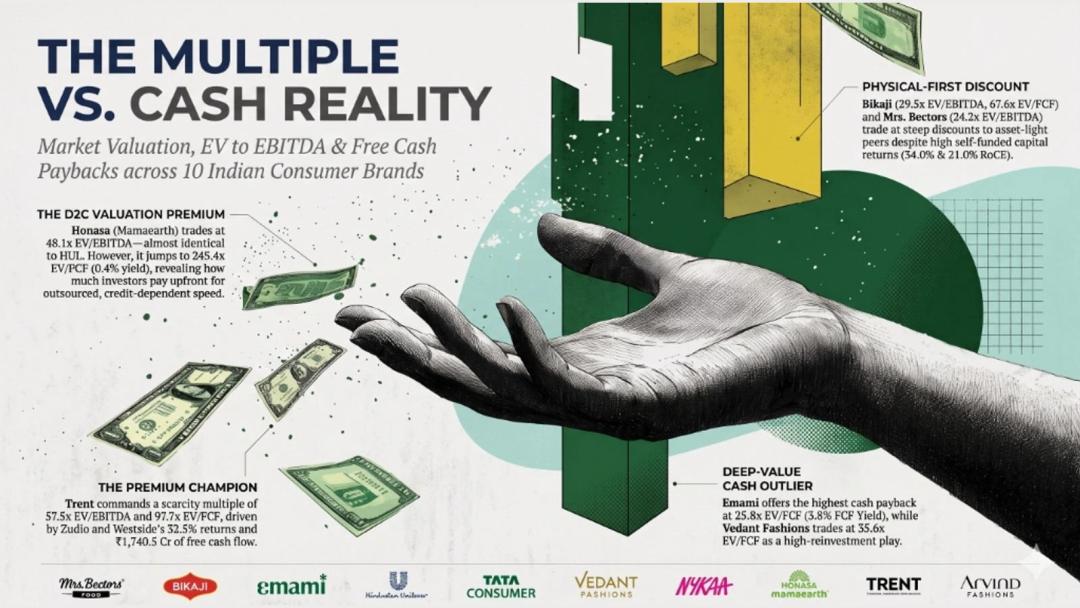
Comparing live stock market pricing across 10 Indian consumer peers reveals that standard earnings multiples routinely hide real cash payback timelines. The public market pays a steep upfront premium for asset-light top-line growth (like Honasa at 245.4x EV/FCF), while heavily discounting highly efficient, self-funding operators (like Bikaji and Bectors) that own their production—proving that market-pricing metrics rarely reflect true operational risk or free cash flow
Explore dynamic charts, regression models, sensitivity analyses, and raw data tables in a dedicated interactive view.
When valuing consumer and retail companies, headline earnings multiples often tell only half the story. Two brands can trade at the exact same price-to-earnings or enterprise-value multiple while generating vastly different amounts of actual surplus cash underneath.
To see what public market investors are truly paying for across 10 listed Indian consumer and retail brands, I compared each company’s live Market Capitalization and Enterprise Value against a standardized operating profit baseline (assuming a 15% operating margin) and actual Free Cash Flow left over after annual capital expenditure.
Lining up market valuations against real cash generation reveals three sharp pricing patterns.
Yet the moment you measure Honasa’s market value against actual surplus cash left over after expansion, that multiple jumps to 245.5 times Free Cash Flow - a free cash flow yield of just 0.4%. By contrast, HUL trades at 47.6 times Free Cash Flow (a 2.0% cash yield). Investors are paying a steep upfront premium for Honasa’s top-line momentum, even though its cash generation still leans heavily on stretched supplier payment cycles rather than self-funding plant assets.
Bikaji Foods - which manufactures nearly 96% of its snacks in-house, earns a 34.0% return on capital, and generates ₹184.5 Cr in annual free cash flow - trades at 29.5 times estimated operating profit (67.6x Free Cash Flow). That represents roughly a 39% valuation discount to Honasa despite owning its factories, controlling raw-material costs, and funding expansion entirely from internal cash. Mrs. Bectors Food sits even lower at 24.2 times estimated operating profit, priced conservatively while heavy investments in new biscuit and bakery lines temporarily hold back its near-term free cash.
At the opposite end sits Emami. Because its top-line growth has been slower, the market prices it at just 25.8 times Free Cash Flow - offering the highest cash yield in the entire cohort at 3.8%. Meanwhile, Vedant Fashions trades at 35.6 times Free Cash Flow (2.8% cash yield), priced for an eventual cash payoff once its heavy commitments to store inventory and franchisee credit convert back into liquidity.
The Core Takeaway Public market multiples routinely reward headline revenue speed, but long-term investor returns still anchor to free cash flow yield. Factory-free brands often carry high valuation multiples that leave little room for error when customer acquisition or vendor credit tightens, while self-funding operators like Bikaji and Trent pair productive physical assets with durable cash generation that compounds year after year.
Questions, alternative perspectives, useful resources, and reviews from fellow researchers and readers.
Analyzing cash flows and reinvestment across 10 Indian consumer brands shows that high paper returns often hide real cash traps. While factory-free brands like Mamaearth rely on stretched supplier credit to post strong returns, physical-first compounders like Trent and Bikaji aggressively self-fund new stores and factories while retaining massive free cash flow—proving durable growth comes from productive assets, not accounting shortcuts.
The textbook pitch for factory-free consumer brands is that outsourcing frees up capital for superior returns, but a statutory analysis of 10 listed Indian players reveals that skipping the factory floor actually forces brands to become inventory-heavy in the warehouse—carrying nearly three times more finished stock (an average of 90 days vs. 32 days for in-house manufacturers) to satisfy third-party order minimums. While some outsourced brands like Honasa (Mamaearth) still post strong cash returns by stretching supplier payables to 190 days to fund this slow-moving stock, physical-first compounders generate durable, resilient cash without relying on vendor credit—Trent by investing heavily in storefronts that collect customer cash almost instantly, and Bikaji by running high-velocity, owned snack factories that turn inventory every three weeks. Ultimately, every consumer model pays a capital tax; the winning formula lies not in being "asset-light," but in ensuring capital isn't trapped in bloated warehouse buffers or high customer acquisition costs.
In public markets, investors often fall in love with high product margins. Looking closely at five years of annual financial reports across ten major Indian consumer and retail companies tells an entirely different story. Once you connect what a company spends to make its products with what it spends to get customers to buy them, that apparent advantage disappears.


