Loading Forvm homepage…

Loading Forvm homepage…
In public markets, investors often fall in love with high product margins. Looking closely at five years of annual financial reports across ten major Indian consumer and retail companies tells an entirely different story. Once you connect what a company spends to make its products with what it spends to get customers to buy them, that apparent advantage disappears.
Explore dynamic charts, regression models, sensitivity analyses, and raw data tables in a dedicated interactive view.
In public markets, investors often fall in love with high product margins. When a modern digital consumer brand reports that it makes 70% gross profit on its products, it looks like an unbeatable business. Meanwhile, traditional food and snack companies that make only 40% to 45% are often brushed aside as slow, heavy, and low-margin.
Looking closely at five years of annual financial reports across ten major Indian consumer and retail companies tells an entirely different story. Once you connect what a company spends to make its products with what it spends to get customers to buy them, that apparent advantage disappears.
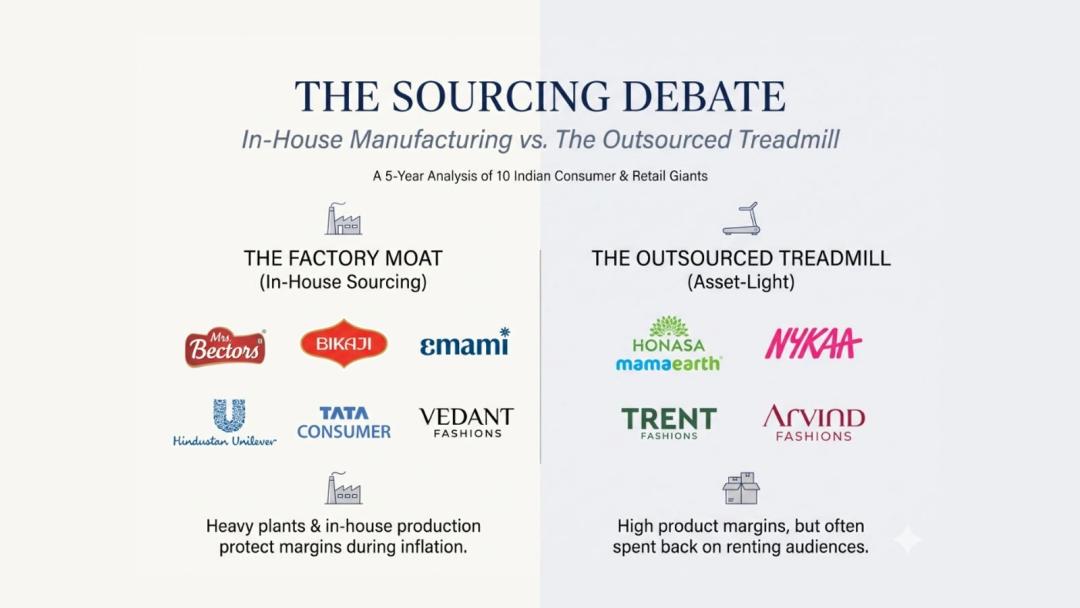
Looking at how these companies report their material costs reveals three distinct approaches:
1. The In-House Manufacturers Companies like Bikaji Foods (96% in-house) and Mrs. Bectors (96% in-house) buy raw ingredients directly—flour, edible oils, sugar, and spices. They process, bake, and package everything inside their own factories. Their capital is tied up in physical plants and machines, which leaves them directly exposed to commodity price swings.
2. The Outsourced Brands Companies like Honasa Consumer (Mamaearth) and Arvind Fashions buy ready-made goods directly from outside suppliers. Their reports show zero direct raw ingredient purchases. Instead, they buy finished bottles and clothes from third-party manufacturers. They do not invest in factory machines; they run on supply contracts.
3. The Hybrids Giants like Hindustan Unilever, Emami, and Tata Consumer use a mixed setup. They make their core, proprietary formulas in their own factories, but outsource high-volume packaging and standard product lines to third-party partners.
The core problem with looking only at product margin is assuming that a 70% margin translates into real cash.
A brand that outsources everything avoids the cost of buying land and building plants. That is how a company like Mamaearth posts a 70.5% product margin. But because it doesn't own factory equipment or entrenched retail shelf space, it has to constantly pay for online attention.
Our numbers show Mamaearth spends roughly 31 paise on advertising for every single new rupee of sales. Once that customer acquisition cost is factored in, its actual retained margin drops to about 39.5%.
Emami shows an even sharper version of this trade-off. It reports a strong 67.4% product margin, but requires nearly 45 paise in advertising for every new rupee of revenue. Its real retained margin on growth drops to just 22.7%.
In these models, a high product margin isn't pure profit. It is simply the budget required to pay Meta, Google, and influencers to keep sales moving.
Now look at traditional manufacturers like Bikaji and Mrs. Bectors.
Their reported product margins look modest at 41.9% and 45.4%. But their advertising drag is tiny: Bikaji spends only 3.2 paise on ads per new rupee of sales, while Mrs. Bectors spends 8.9 paise.
They can operate this way because their competitive edge sits on the ground. Having large, automated factories and established relationships with hundreds of thousands of local corner shops (kiranas) means their products sell based on physical availability and everyday price. They don't have to win an online ad auction every morning to sell a pack of biscuits or bhujia.
When you subtract their low ad costs from their product margins, Bikaji holds onto 38.7% of its incremental revenue—almost identical to Mamaearth’s 39.5%. One company achieves this by renting online ad space, while the other does it by owning physical production lines.
The usual assumption is that companies without factories handle rising costs better because they can switch suppliers or negotiate. The steep price spike in cooking oil, wheat, and packaging during FY22 and FY23 proved the opposite.
Factory owners adjusted almost immediately. Bikaji and Mrs. Bectors kept their margin drops under 2.6 percentage points. Because they control the factory floor, they quietly trimmed pack weights by a couple of grams while keeping the retail price at a flat ₹5 or ₹10. Customers barely noticed, and unit profitability stayed intact.
Outsourced brands faced a delayed hit. Third-party suppliers absorbed higher raw material costs for a short time before passing on steep price increases. Without direct control over the machinery, outsourced brands were forced to raise shelf prices directly, risking customer pushback.
Trent operates completely on outsourced manufacturing, yet its incremental ad spend is zero.
Instead of paying digital platforms to rent an audience, Trent uses physical retail stores as its marketing engine. By placing large stores in high-footprint locations and keeping prices very low, it lets store foot traffic replace social media advertising. Trent achieves the speed of an outsourced supply chain without getting trapped on the digital marketing treadmill.
Evaluating a consumer brand purely on its headline gross margin misses the bigger picture.
A company with a 70% margin that spends 30 paise on ads leaves behind the exact same cash as a factory owner with a 42% margin who spends 3 paise on ads.
One rents social media algorithms to find buyers; the other owns the physical machines and local shop shelf space. When commodity prices surge or digital ad costs climb, owning the factory floor often proves far more resilient than renting it.
Questions, alternative perspectives, useful resources, and reviews from fellow researchers and readers.
Comparing live stock market pricing across 10 Indian consumer peers reveals that standard earnings multiples routinely hide real cash payback timelines. The public market pays a steep upfront premium for asset-light top-line growth (like Honasa at 245.4x EV/FCF), while heavily discounting highly efficient, self-funding operators (like Bikaji and Bectors) that own their production—proving that market-pricing metrics rarely reflect true operational risk or free cash flow
Analyzing cash flows and reinvestment across 10 Indian consumer brands shows that high paper returns often hide real cash traps. While factory-free brands like Mamaearth rely on stretched supplier credit to post strong returns, physical-first compounders like Trent and Bikaji aggressively self-fund new stores and factories while retaining massive free cash flow—proving durable growth comes from productive assets, not accounting shortcuts.
The textbook pitch for factory-free consumer brands is that outsourcing frees up capital for superior returns, but a statutory analysis of 10 listed Indian players reveals that skipping the factory floor actually forces brands to become inventory-heavy in the warehouse—carrying nearly three times more finished stock (an average of 90 days vs. 32 days for in-house manufacturers) to satisfy third-party order minimums. While some outsourced brands like Honasa (Mamaearth) still post strong cash returns by stretching supplier payables to 190 days to fund this slow-moving stock, physical-first compounders generate durable, resilient cash without relying on vendor credit—Trent by investing heavily in storefronts that collect customer cash almost instantly, and Bikaji by running high-velocity, owned snack factories that turn inventory every three weeks. Ultimately, every consumer model pays a capital tax; the winning formula lies not in being "asset-light," but in ensuring capital isn't trapped in bloated warehouse buffers or high customer acquisition costs.


