Loading Forvm homepage…

Loading Forvm homepage…
Acorns is a U.S.-based WealthTech and financial wellness company that makes investing and saving simpler through automated, easy-to-use financial products. In 2021, it agreed to a $2.15B SPAC merger that would have taken the company public as OAKS, but the deal was terminated in January 2022 amid the broader fintech and SPAC downturn. Despite remaining private, Acorns continued expanding its ecosystem and reached 6.8M subscribers by 2026, while pursuing much of the growth strategy originally planned. Project OAKS explores what Acorns might be worth today if the merger had closed, with the valuation model estimating $5.35–$20.46 per share across Bear, Base and Bull scenarios.
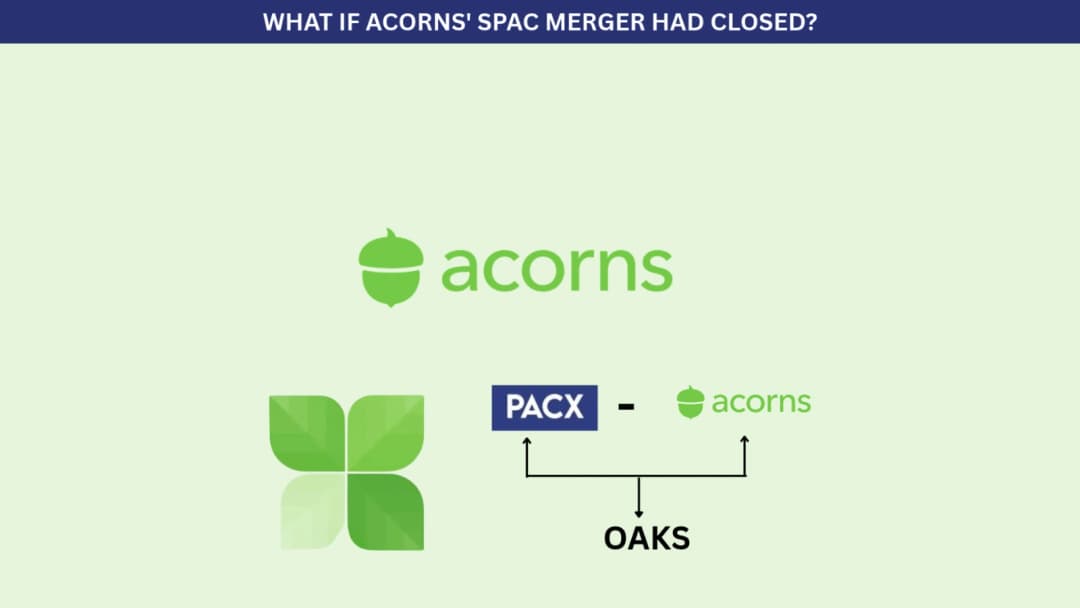
Acorns is a U.S.-based WealthTech and financial wellness company that helps people invest, save and manage money through automated financial products. Founded in 2012, it gained recognition for its Round-Ups® feature, which automatically invests spare change from everyday purchases. It subsequently expanded into investing, banking, retirement, family finance and financial education, with a focus on making wealth-building more accessible to first-time and younger investors.
In 2021, Acorns stood on the threshold of the public markets. The company agreed to merge with Pioneer Merger Corp. in a proposed SPAC transaction valued at approximately $2.15 billion, with $622.5 million in expected gross transaction proceeds intended to support its next phase of growth. The proposed Nasdaq listing under the ticker OAKS was expected to facilitate expansion, acquisitions and product development. However, amid deteriorating SPAC sentiment and falling fintech valuations, the transaction was terminated in January 2022, leaving Acorns private. Refer to Section 1: The Aborted SPAC Merger in the accompanying presentation for the deal structure and capital breakdown.
Beyond the transaction, Acorns was evolving from a spare-change investing application into a broader financial wellness ecosystem spanning investing, banking, retirement, family finance and financial education. Its core proposition centred on Gen Z and Millennial consumers seeking accessible alternatives to traditional financial products. The 3CP analysis in Section 2 examines the company's business model, target customers, competitive landscape and product ecosystem.
The termination of the SPAC did not end Acorns' growth ambitions. In March 2022, the company raised $300 million in Series F financing at a reported $1.9 billion valuation. It continued developing its product ecosystem and pursuing acquisitions, including GoHenry in 2023. By mid-2026, the subscriber figure used in this analysis was approximately 6.8 million, below the previously stated target of 10 million subscribers by 2025. Subsequent strategic developments, including the sale of GoHenry to Barclays in 2026, further illustrate how the company's portfolio continued to evolve. The Planned vs. Actual Execution section examines these developments against the original strategic ambitions.
These developments lead to the central question behind Project OAKS: What might Acorns be worth in 2026 if the Pioneer SPAC merger had closed? Rather than treating OAKS as an actual traded security, this study approaches the question through a counterfactual valuation framework. Using Comparable Company Analysis (CCA) and Bear, Base and Bull scenarios, the model estimates hypothetical share prices of $5.35, $10.72 and $20.46, respectively. The underlying assumptions, valuation drivers and calculations are detailed in the OAKS 2026 Scenario Valuation Framework and accompanying valuation memorandum.
The central finding is that the abandoned transaction did not necessarily represent a lost growth strategy; Acorns continued pursuing many of its original ambitions through private financing, product development and acquisitions. However, subscriber growth below the original target, changing strategic priorities and the post-2021 fintech valuation reset complicate the counterfactual outcome. The analysis suggests that market valuation multiples and transaction timing could have materially influenced OAKS' hypothetical public-market value alongside operating performance. The Base Case estimate of $10.72 per share, close to the proposed $10 transaction price, provides a useful point of comparison—not proof of the price at which OAKS would actually have traded.
Ultimately, Project OAKS examines how the transaction's completion might have changed Acorns' financing, ownership and growth trajectory, while recognising that its hypothetical valuation remains dependent on assumptions and information available for the analysis.
Questions, alternative perspectives, useful resources, and reviews from fellow researchers and readers.
Comparing live stock market pricing across 10 Indian consumer peers reveals that standard earnings multiples routinely hide real cash payback timelines. The public market pays a steep upfront premium for asset-light top-line growth (like Honasa at 245.4x EV/FCF), while heavily discounting highly efficient, self-funding operators (like Bikaji and Bectors) that own their production—proving that market-pricing metrics rarely reflect true operational risk or free cash flow
Analyzing cash flows and reinvestment across 10 Indian consumer brands shows that high paper returns often hide real cash traps. While factory-free brands like Mamaearth rely on stretched supplier credit to post strong returns, physical-first compounders like Trent and Bikaji aggressively self-fund new stores and factories while retaining massive free cash flow—proving durable growth comes from productive assets, not accounting shortcuts.
The textbook pitch for factory-free consumer brands is that outsourcing frees up capital for superior returns, but a statutory analysis of 10 listed Indian players reveals that skipping the factory floor actually forces brands to become inventory-heavy in the warehouse—carrying nearly three times more finished stock (an average of 90 days vs. 32 days for in-house manufacturers) to satisfy third-party order minimums. While some outsourced brands like Honasa (Mamaearth) still post strong cash returns by stretching supplier payables to 190 days to fund this slow-moving stock, physical-first compounders generate durable, resilient cash without relying on vendor credit—Trent by investing heavily in storefronts that collect customer cash almost instantly, and Bikaji by running high-velocity, owned snack factories that turn inventory every three weeks. Ultimately, every consumer model pays a capital tax; the winning formula lies not in being "asset-light," but in ensuring capital isn't trapped in bloated warehouse buffers or high customer acquisition costs.


