Loading Forvm homepage…

Loading Forvm homepage…
The report, "Is the VCs Vehicle Shift is Real" investigates whether traditional 10-year closed-end limited partnership (LP) fund structures in venture capital are being permanently replaced by alternative vehicles like evergreen/semi-liquid funds, GP-led continuation vehicles, and alternative exit routes (M&A, tender offers). Using the Venture Dissonance framework (which identifies a mismatch between rigid 10-year fund terms, accelerated 12–24 month AI technology cycles, and 2–3 year exit cycles) and cross-checking it against Yale’s Endowment Model, the report evaluates industry growth data, real-world case studies, and structural failure points. It concludes that alternative vehicles do not represent a uniform, industry-wide replacement of traditional venture funds. Instead, adoption is segment-specific: high feasibility is concentrated among large, well-resourced managers, while mid-size and emerging managers face steep operational, governance, and NAV infrastructure barriers.

About This Report
This report asks whether the newer structures reshaping venture capital, namely evergreen funds, GP-led continuation funds and alternative exit routes, should become the industry standard or remain tools for particular kinds of firms. Its central finding is that the evidence supports segment-specific evolution, not wholesale replacement.
These structures widen the private-markets toolkit, but they redistribute risk rather than remove it, trading long lockups for redemption gates, valuation complexity and governance conflicts. Feasibility is demonstrated almost entirely among large, multi-stage managers with strong brands, established LP trust and the operating infrastructure to support them, and remains conditional or limited for mid-size and emerging managers. The evidence also shows no consistent return advantage over traditional drawdown funds across market cycles, so the case for these vehicles rests on structural fit and liquidity management rather than performance.
The analysis begins with how the closed-end limited partnership, rooted in an 1822 New York statute and standardized in the 1970s, endured for decades, reinforced by a carried interest tax advantage that has survived at least seven repeal attempts since 2007. It then tests the Venture Dissonance framework, a recent and still unvalidated hypothesis about mismatched timelines in capital, technology and exits, against current market data. U.S. dry powder reached $311.2 billion, AI captured 65.6% of U.S. venture deal value in 2025, and median fund distributions across the past decade remain below 1.0x paid-in capital. An independent lens from endowment theory points the same way: Ivy League endowments returned 8.3% a year over sixteen years, against 9.8% for a simple equity-bond index, and Yale and Harvard have reportedly been selling private equity stakes to raise cash.
The report then measures how quickly the new structures are spreading. Evergreen assets reached roughly $457 to $500 billion by 2025, GP-led secondary volume rose from about $15 billion in 2021 to $116 billion in 2025, and M&A now accounts for roughly 68% of startup exits. Named cases show different forms of adoption: Sequoia's $19 billion evergreen conversion, Lightspeed's selective use of continuation funds, B37 Ventures' evergreen model at roughly $130 million in assets, and Stripe's tender offer at a $50 billion valuation. These are set against documented failure modes. Blackstone's $69 billion BREIT met only 15% of $4.5 billion in redemption requests in March 2023, Partners Group gated its $8.6 billion evergreen fund in 2026, continuation funds have required repeated governance intervention, and Adobe's $20 billion acquisition of Figma collapsed after fifteen months of regulatory review. A cross-check of returns and fees finds evidence that shifts with market conditions, with drawdown private equity funds historically ahead of evergreen strategies by about 2.25 to 2.75 percentage points a year in one source, while others show evergreen ahead in recent periods.
These findings are consolidated into a feasibility matrix by vehicle and firm segment and translated into a practical self-assessment tool, so general partners and limited partners can judge where their own firm sits and which structures are realistic for it. Throughout, conclusions are scoped to the evidence available, and where sources disagree, both positions are shown.
Structured responses, alternate methodologies, follow-up literature, and peer validation attached to this report.
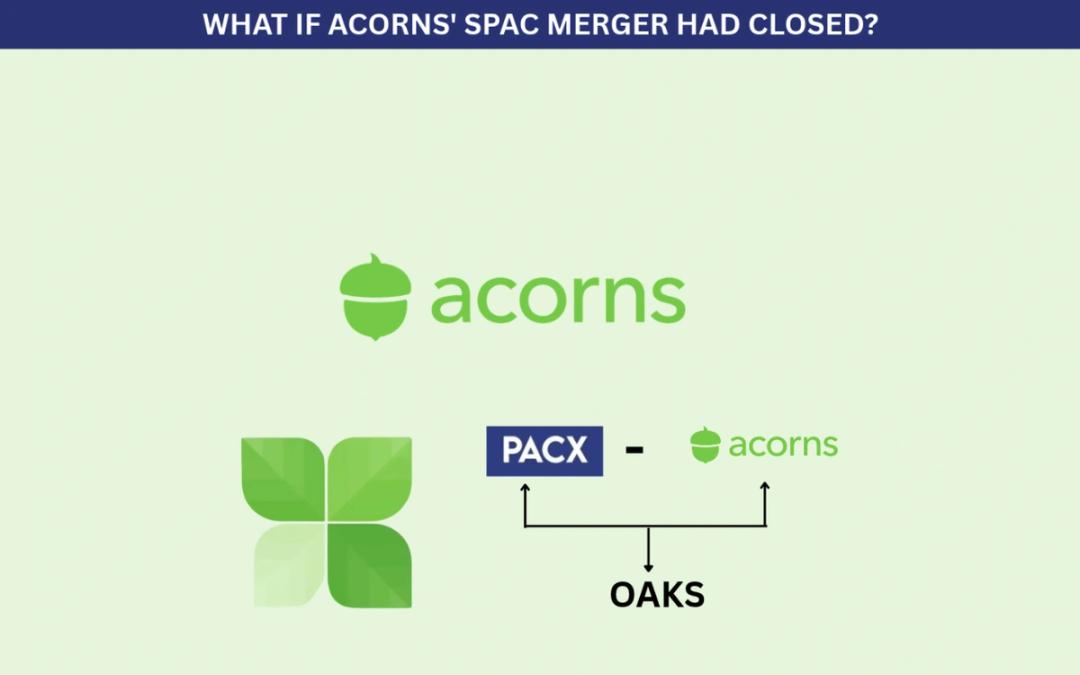
Acorns is a U.S.-based WealthTech and financial wellness company that makes investing and saving simpler through automated, easy-to-use financial products. In 2021, it agreed to a $2.15B SPAC merger that would have taken the company public as OAKS, but the deal was terminated in January 2022 amid the broader fintech and SPAC downturn. Despite remaining private, Acorns continued expanding its ecosystem and reached 6.8M subscribers by 2026, while pursuing much of the growth strategy originally planned. Project OAKS explores what Acorns might be worth today if the merger had closed, with the valuation model estimating $5.35–$20.46 per share across Bear, Base and Bull scenarios.